British supercar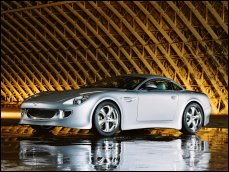
A British-made supercar with class-leading handling and road-holding!
Engine & Performance
Fundamental to the manufacturer’s desire to deliver no-compromise performance in terms of handling balance and sheer speed, was the decision to mount the car’s engine and gearbox well back in the chassis and the 100-litre fuel tank transversely between the rear wheels, to achieve close to the ideal 50/50 front/rear weight distribution.
Fitted with the manufacturer’s own air-intake and exhaust systems, the 4.6 and 5.0 litre engines powering the S1 range are supplied by Ford’s Special Vehicle Team (SVT) in . Light, smooth-revving and ultra-reliable, these engines deliver stunning acceleration in the 1380 kg S1. Each engine is hand-built at Ford’s SVT facility and carries a plaque signed by the two technicians responsible for its assembly. However, these engines may be upgraded by the manufacturer as necessary to produce up to 600 bhp.
The completely flat floor of the S1 and the rising rear undertray give low-drag and generate downforce. Tests in the full size wind tunnel at MIRA confirm that the car will remain stable if driven at speeds in excess of 200 mph - where road conditions permit.
The combination of high power, massive torque and low weight is a recipe for good fuel economy and wonderful performance.
Safety & Styling
The car’s spaceframe chassis is believed to be the strongest ever tested by car safety officials. The carbon composite semi-monocoque construction of the car bonds carbon fibre floor panels above and beneath the steel tube frame and also incorporates many safety features including: side-impact bars, rear-impact beam, seats positioned within the steel frame chassis, a full roll-over safety cage and Kevlar reinforcement of the doors, front and rear bumpers and windscreen surround.
The manufacturer wanted the car’s appearance to reflect its commitment to building a no-compromise sportscar in which performance and handling take priority, but practicality and comfort are not forgotten. Engineering decisions, about dimensions, engine location and weight distribution came first and body styling followed. The designer and his studio say they regard the car as “an excellent opportunity to use the ‘timeless classic’ bold proportions of a high body-side and a sleek glass area.”
Suspension & Steering
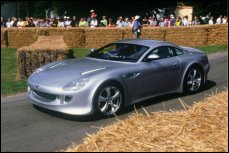
Building on the major attributes of a stiff body/chassis structure and balanced weight distribution, the car’s suspension adopts a tried and proven classic layout and employs a pair of unequal length, double wishbones front and rear with anti-roll bars. Designed and produced in-house, the wishbones carry compact uprights developed jointly with AP and manufactured in-house. Specially developed suspension bushes ensure precise mounting of the wishbones, with sufficient insulation from road shocks to maintain good ride comfort.
The car comes with coil springs and dampers tuned to give the best possible blend of ride and handling. The dampers are easily adjustable for using the car on track days. Customers wishing to exploit the car’s undoubted race car potential, will also find that camber, castor and anti-roll bar settings are all adjustable over a wide range. The power steering is beautifully weighted providing positive feeback to the driver, and requires three turns of the steering wheel lock-to-lock.
Brakes, Wheels & Tyres
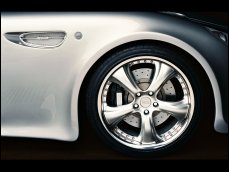
With four large-diameter, cross-drilled and ventilated discs, the braking system of the car is very close to a racing configuration, with AP 6-pot (front) and 4-pot (rear) brake calipers. The standard set-up uses anti-squeal brake pads and calipers for quiet operation in normal road use. A change of pad material will ensure that the car can be used all day on a race track without running out of brakes.
British designed – Italian made, five-spoke cast alloy wheels provide an aggressive compliment to the smooth flanks of the car. Nineteen inches in diameter, the 8.5 inch wide (front) and 9.5 inch (rear) wheels offer a clear view of the massive discs and their branded brake calipers. The wheels are shod with ultra-low profile, 35 section, directional tyres, in two widths – 255 (front) and 275 (rear) supplied by TOYO.
Interior, Comfort & Refinement
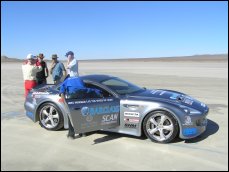
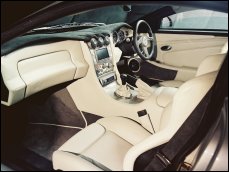
Although the car has all the vital credentials to deliver maximum road and track performance, its role as a Grand Tourer has not been overlooked. The double floor section between the wheels sandwiches a 40mm layer of sound-proofing and throughout the car, great attention has been paid to isolating the occupants from the hardware and the heat it generates, but not from the thrill of driving.
From the concept stage, the manufacturer was determined that the car would have a spacious cabin, with particularly generous head and leg room. The supportive seats are trimmed to match the interior, and offer a wide range of movements, together with adjustable lumbar support.
The steering wheel is adjustable for reach and rake, and its 14-inch diameter rim frames an array of bespoke traditional instruments. The wide centre console is trimmed in brushed aluminium and topped by triple air-vents. It houses satellite navigation as standard, together with controls for the climate-control, air conditioning and the car audio equipment. Both front and rear windscreens are electrically heated and the car features a filler on each rear wing so that the fuel tank can be replenished from either side.
Models
There are three models in the range, all of which have 2 seats or 2+2. All are available in right-hand or left-hand drive.
Engine and Estimated Performance Figures
Model 1:
4.6 litre engine.
V8 aluminium block and cylinder head.
Maximum power: 320 bhp at 5900 rpm.
Acceleration, 0 – 60 mph: 5.2 seconds.
Maximum speed: 170+ mph.
Model 2:
4.6 litre engine.
V8 aluminium block and cylinder head.
Maximum power: 420 bhp at 5900 rpm.
Acceleration, 0 – 60 mph: Under 5.0 seconds.
Maximum speed: 170+ mph.
Model 3:
5.0 litre engine.
V8 Supercharged.
Maximum power: 600 bhp at 4500 rpm.
Acceleration, 0 – 60 mph: 3.8 seconds.
Maximum speed: 200+ mph.
Safety, luxury and comfort at any speed!
Contact Red Dragon Motorsport (UK) for more information on this manufacturer / car:
davidjones@etc-inter.net | | | | | | | | | | | | | |
|
|